
An air curtain on its own is enough when the opening has to stay open or is used almost continuously, and the goal is to reduce air exchange, dust and insects without getting in the way of people or goods. You need a high-speed door when the two zones must be physically separated, when air exchange needs tighter control, or when the opening has to be closed and secured. On many sites the best answer is both.
The question comes up often in warehouses, food plants, large retail stores and service entrances, where traffic is constant and every opening costs cooling energy. This guide explains the difference in function, which situations suit each option, and the coordination with HVAC and electrical engineers needed before a decision is made.
How do they work differently?
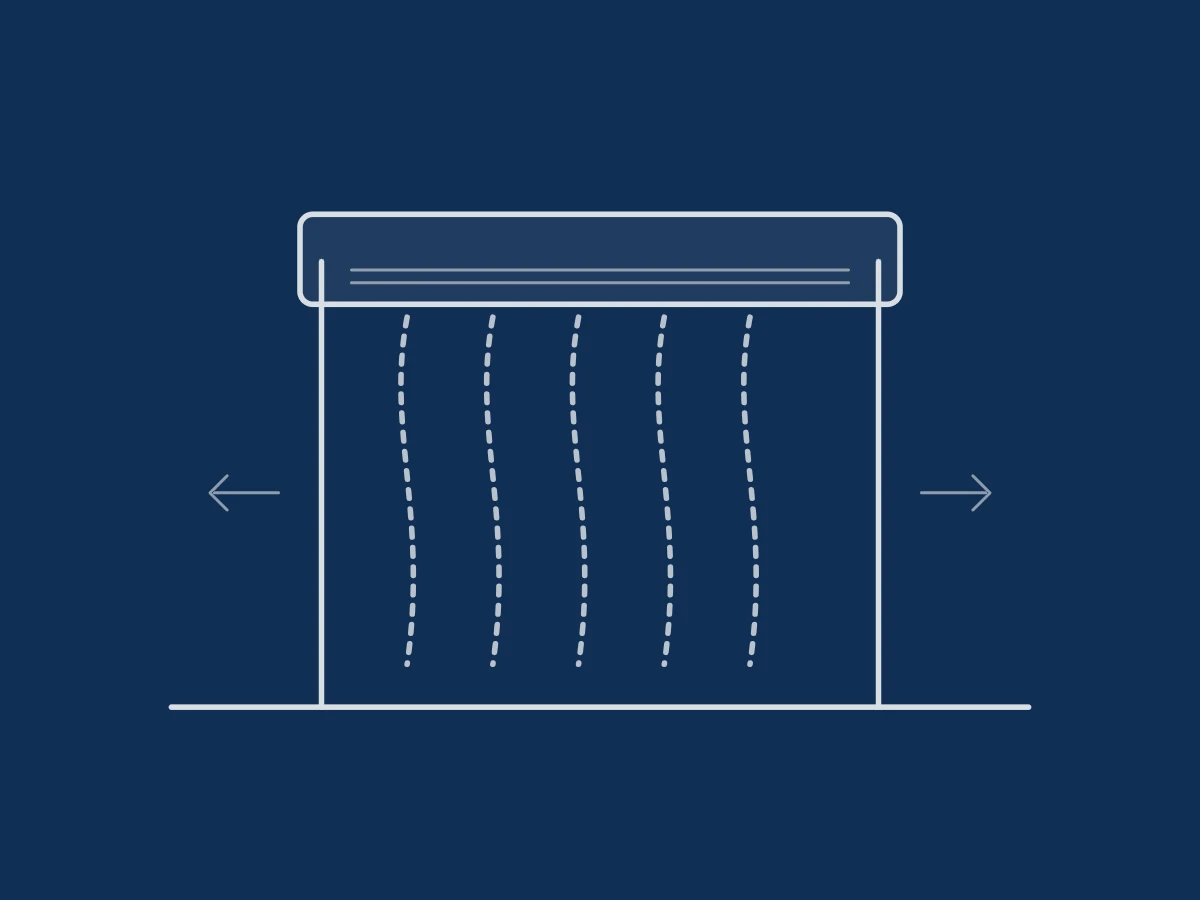
An industrial air curtain is usually mounted above the opening and blows a directed stream of air across it. This reduces mixing between inside and outside air and limits dust and insects, while the opening stays clear for traffic. A high-speed door is a physical barrier that opens and closes quickly as traffic passes, so the opening stays closed most of the time and air exchange between zones drops.
Put simply: an air curtain improves an open opening, while a high-speed door reduces how long the opening is open in the first place.
How do the two compare?
| Factor | Air curtain | High-speed door |
|---|---|---|
| Physical separation | None, the opening stays open | Yes, when closed |
| Traffic flow | Pass straight through, no waiting | Opens on approach, closes after passage |
| Dust and insects | Reduced, depending on site conditions | A clearer barrier while closed |
| Out-of-hours security | Does not secure the opening | May need an additional security door depending on the site |
| Wind and pressure difference | Performance noticeably affected | Less affected when closed |
| Coordination | Power, mounting above the opening, HVAC | Power, control panel, sensors and safety devices |
| Maintenance | Cleaning and periodic checks | Periodic service of moving parts and sensors |
When is an air curtain alone enough?
- The opening must stay open: customer entrances in some stores, or service hatches.
- Continuous traffic: where a door would be open most of the time anyway.
- A limited goal: reducing insects, dust or hot air, not full separation.
- Small difference between zones: in temperature or pressure, and no strong direct wind.
- No security closure needed: or another door closes the opening after hours.
When do you need a door?
- Large difference between zones: a chilled area next to an ambient one, or a cooled interior facing hot, dusty outdoors.
- Hygiene or separation requirements: where dust, odours or air must not pass between areas.
- Wind or significant pressure difference: which weakens an air curtain on its own.
- The opening must close: for security or operational reasons.
- Intermittent traffic: where the opening can stay shut between passes.
If you are weighing a high-speed door against other door types, see when you need a high-speed door.
Can you combine an air curtain and a high-speed door?
Yes. It is a common approach for openings that stay open for long spells during loading or forklift traffic. The door is the main barrier, and the air curtain works while the door is open. In many cases the air curtain can be linked to the door so it runs only when the door opens. How this is done depends on the project and the control system.
In the Egyptian market, our team has previously delivered air curtain work for clients in the food industry, where openings like these are common.
Why coordinate with HVAC and electrical engineers?
Both options interact with building services, so bring the MEP engineers in from the start.
- Pressure balance: the pressure difference created by the ventilation system affects how well an air curtain performs.
- Cooling loads: the HVAC engineer is best placed to judge the effect of each option on the conditioned or chilled zone.
- Power supply: suitable supply points for each unit, coordinated with the electrical engineer and contractor.
- Mounting above the opening: check the available space and clashes with ducts and services.
- System links: linking the air curtain to the door, or to a building management system if there is one, should be shown on the drawings early.
Vally World offers engineering consultation to compare both options for a specific opening and coordinate requirements with the consultant and contractor.
What should you ask the supplier?
- Which problem does the proposal address: heat, dust, insects, or separation between zones?
- How were site conditions such as wind direction, pressure difference and open time taken into account?
- How much space is needed above and around the opening, and does it clash with existing services?
- What power and control works are needed, and are they in the supplier scope or with the owner or contractor?
- Can the air curtain be linked to the door, and how would that work on this project?
- What does routine maintenance cover for each option, and what warranty terms are stated in the quotation?
Common mistakes
- Expecting full separation from an air curtain: its job is to reduce, not to block.
- Ignoring wind and pressure: when specifying an air curtain for an exposed external opening.
- Fitting a high-speed door to an opening that is always open: so its fast closing is never used.
- Skipping HVAC coordination: and finding out later the solution does not meet the goal.
- Comparing purchase price only: instead of the effect on operations, energy and maintenance.
Next step
Send photos of the opening, a description of the zones on each side, the type of traffic and what you want to reduce or keep out through the Request a Quote page. The Vally World team will recommend an air curtain, a door, or a combination of both.
To learn more about energy efficiency programmes for buildings and facilities, see the Saudi Energy Efficiency Center.
Frequently asked questions
Does an air curtain keep dust out completely?
No. An air curtain reduces dust, insects and air mixing, and how much depends on site conditions such as wind and pressure difference. If you need clearer separation, a door or a combination of both is the better fit.
Can an air curtain be added to an opening that already has a door?
Often, yes, provided there is suitable space above the opening and a power point, and it does not clash with the door movement or existing services. This is checked during the site visit.
Can the air curtain switch on automatically when the door opens?
In many cases it can be linked to the door status. The method depends on the control system on each project.
Which option costs less?
There is no general answer. Cost depends on opening size, usage, control requirements and related works. Compare the two on what they achieve for your operation, not on supply price alone.