
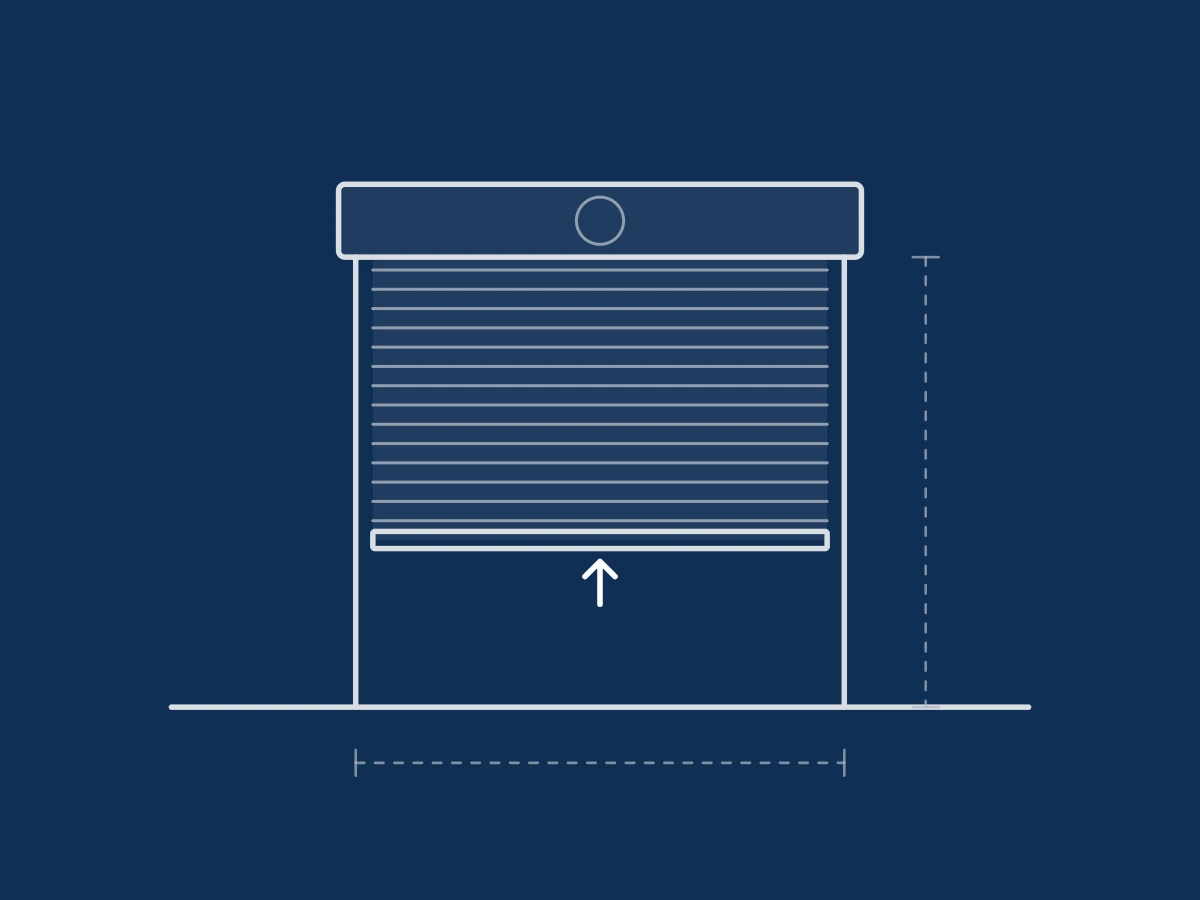
Roller door vs roller shutter: the difference is mainly the curtain design. A roller shutter is a curtain of interlocking horizontal metal slats that coils around a barrel above the opening; it is the common type in warehouses, factories and shops in Saudi Arabia because it is robust and is available with insulated or perforated slats and industrial motors. A roller door, in most usage, is a curtain of a single flexible corrugated steel sheet that coils in the same way; it is lighter and common in garages and small openings.
In the local market the two terms, along with “roll-up door” and “shutter”, are often used interchangeably, so do not rely on the name in your request: state the curtain type, material, thickness, motor type and daily cycles so the quotations you receive are comparable.
This guide is for facility, procurement, warehouse and factory managers in Riyadh, Jeddah, Dammam and across the Kingdom who receive quotations under different names for the same opening and want to know whether they are comparing like with like. It does not replace the detailed specification guide to roller shutter doors for warehouses and factories in Saudi Arabia; it clarifies the terms before it.
Why are the two terms mixed up?
Roller door vs roller shutter confuses many buyers because the mechanism is the same: a curtain moving in side guides and coiling on a barrel above the opening instead of sliding or swinging on hinges. And because the names entered the market from more than one country and language, some suppliers call every coiling door a “roller door”, others call it a “roller shutter”, and others say “roll-up” or simply “shutter”. As a result, two offers with the same name may be for two very different doors in weight, durability, insulation and motor, and therefore in price and service life.
What is a slatted roller shutter?
A roller shutter is a curtain of horizontal slats that interlock, each with a defined profile. Slats can be:
- Solid single-skin in galvanised steel, aluminium or stainless steel.
- Insulated double-skin with foam filling, to reduce heat and noise transfer.
- Perforated or grille for ventilation and visibility while keeping security.
Because the curtain is made of slats, a damaged slat can often be replaced instead of the whole curtain, and the shutter can be built for wide openings with stronger slats and guides suited to wind load. It runs on a tubular, centre, side-mounted or chain-drive motor depending on weight, as explained in our roller shutter door motor guide.
What is a corrugated roller door?
A roller door in this sense is a curtain of thin corrugated steel sheet, in one piece or a few parts, coiling on a barrel with springs that balance its weight, operated manually or with a small motor. It is light and simple to install, but:
- It has lower impact and wind resistance in large openings.
- It is not usually available with real thermal insulation.
- Damage to part of the sheet may require replacing the whole curtain.
- It is generally not designed for many daily cycles as at loading bays.
So it suits garages, small stores and rarely used openings more than warehouse and factory openings.
Roller door vs roller shutter: quick comparison
| Item | Slatted roller shutter | Corrugated roller door |
|---|---|---|
| Curtain | Interlocking horizontal slats | Flexible corrugated steel sheet |
| Typical use | Warehouses, factories, shops, loading bays | Garages and small stores |
| Sizes | Small to very large openings | Better for small and medium openings |
| Insulation | Available with insulated slats | Usually limited |
| Ventilation and visibility | Available with perforated or grille slats | Not usually available |
| Repair | Individual slats can often be replaced | Damage may require a new sheet |
| Operation | Industrial motors for higher cycles | Manual or light motor |
That is the practical roller door vs roller shutter difference for industrial use. Cost varies with size, material, thickness and motor, so compare offers on specification, not on the name.
For background on how this type of door works, see the Roller shutter article on Wikipedia.
Other “roll” doors that are not shutters
- High-speed (rapid roll) door: a PVC fabric curtain that coils at high speed, used for internal separation and to cut the time an opening stays open, not for after-hours security. See when you need a high-speed door.
- Sectional overhead door: sometimes called an overhead door that lifts, but it is made of large panels that run on tracks under the ceiling and do not coil. The comparison is in rolling vs sectional doors.
Roller door vs roller shutter: which suits your facility?
- Warehouse or factory loading openings used many times a day: a slatted roller shutter with a motor rated for the cycles, or a sectional door if sealing and insulation are the priority.
- Large opening exposed to wind and dust: a slatted roller shutter with slats and guides designed for the size, with seals and brushes to reduce dust ingress.
- Air-conditioned warehouse: at least an insulated-slat roller shutter, or an insulated sectional door.
- Frontage needing ventilation or visibility: a perforated or grille roller shutter.
- Small, rarely used garage or store: a corrugated roller door may be enough.
How to write the request so suppliers quote the same thing
Whatever the roller door vs roller shutter name in the offer, the specification is what matters. Instead of “a roller door of size X”, state in your request for quotation:
- The actual opening size (width × height) and the space available above and beside it.
- The curtain type explicitly: solid, insulated or perforated slats, or corrugated sheet.
- Slat material, thickness and coating.
- Expected opening and closing cycles per day.
- Operation: manual or motorised, available power supply, and manual opening during power cuts.
- Safety devices: bottom safety edge and photocells.
- Location: internal or external, and exposure to wind or coastal humidity in Jeddah, Dammam or Jubail.
After receiving offers, use our method to compare automatic door quotations to check that the items match, and see the information needed for a quotation.
Next step
If you are not sure which curtain suits your opening, request a site survey and measurements, or browse roller shutters and roll-up doors and sectional doors, then send the opening size, type of use and daily cycles through the quotation request page.
FAQ: roller door vs roller shutter
Roller door vs roller shutter: are they the same thing?
The idea is the same, as both coil on a barrel above the opening, but they usually mean different curtains: a roller shutter has interlocking slats, while a roller door has a corrugated steel sheet. In the local market the names may be used interchangeably, so ask the supplier for the curtain type.
Roller door vs roller shutter: which is better for a warehouse?
In most warehouses and factories a slatted roller shutter is more suitable, because it is made for large openings, is available with insulated or perforated slats, and uses motors rated for more cycles.
Is a high-speed roll door a type of roller shutter?
No. A high-speed door is a PVC fabric curtain that coils fast for internal separation and shorter opening times, while a roller shutter is a metal curtain for security and closure.
What does “roll-up” mean in quotations?
It is a general name for any door that lifts by coiling, and a supplier may mean a slatted roller shutter, a corrugated roller door or even a high-speed door, so ask for the curtain type, material and thickness in writing.
Can a motor be fitted to a manual roller door?
Usually yes, with a motor suited to its weight after checking the springs and guides, but if the opening will be used many times a day, a slatted roller shutter with an industrial motor may be a better choice.