
Industrial doors on automated production lines are doors connected to the plant’s control system (PLC), conveyors and sensors, so they open and close automatically with the movement of product, forklifts or robots instead of relying on a manual button or an operator. Their success depends on three things: opening and closing speed that matches the line’s rhythm, clear two-way control signals between the door and the line, and safety systems that stop the door hitting product or people.
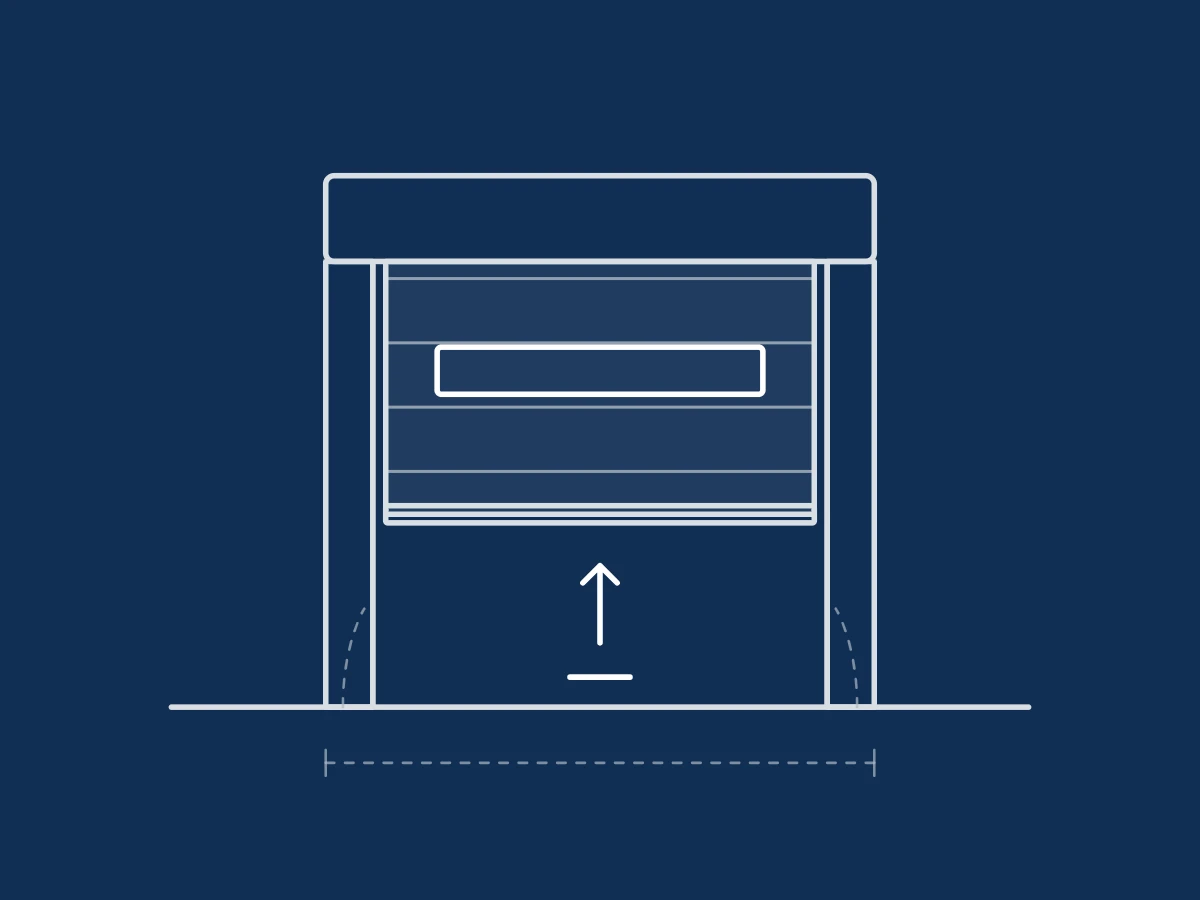
In Saudi factories expanding into automation, especially in the industrial cities of Riyadh, Jeddah, Dammam and Jubail, the door has become part of the production line rather than just an opening in a wall. A slow door, or one not linked to the line, can stop a conveyor, leave an air-conditioned or clean area open longer than needed, or cause an accident with an automated vehicle. This guide explains where these doors are used, which type suits each location, and what to coordinate with the automation team before ordering.
Where do automated lines need doors linked to the control system?
- Conveyor openings between two halls: such as from production to packing or cold storage, where product passes through an opening that should stay closed most of the time.
- Entrances for automated guided vehicles (AGV) and forklifts: between production lines and the warehouse, where the door must open before the vehicle arrives and close after it passes.
- Boundaries of clean and air-conditioned areas: in food, pharmaceutical, plastics and electronics plants, to keep dust and heat out of sensitive production areas.
- Robot cells and hazardous machines: where the door is part of the safety guarding and must not open while the machine runs.
- Loading docks linked to the packing line: to coordinate door opening with shipment and truck readiness.
Which door type suits each location on the line?
| Location | Usually closest type | Why |
|---|---|---|
| High-traffic openings between halls and forklift entrances | High-speed doors | Fast opening and closing that handles many cycles a day and cuts the time the opening stays open |
| Large external openings and truck entrances | Sectional doors or roller shutters | Higher insulation and security, can be linked to control signals but move more slowly |
| Openings that must stay open for continuous product flow | Air curtains with or without a door | Reduce air and dust transfer without stopping product flow |
| Personnel entrances next to the line | Automatic sliding or swing doors | Separate people traffic from equipment traffic |
For a detailed comparison of types in factories and warehouses, see automatic and industrial doors for factories and warehouses, and to know when a high-speed door is essential, see when does your facility need a high-speed door?
How is the door linked to the line control system?
Open and close signals
The simplest link is for the control system to send an “open” signal when product or a vehicle approaches, and a “close” signal once the opening is clear. The open signal can come from a conveyor sensor, the AGV management system, or a radar or ground loop in front of the door.
Status feedback from the door
A good link works both ways: the door sends the line “fully open”, “fully closed” and “fault” signals. The conveyor or vehicle only moves through the opening after full opening is confirmed, and the line stops in an orderly way if the door fails, instead of product hitting a half-open door.
Priority and conflicts
The automation team must define priority: does the door open for any approaching vehicle, or only on the line’s request? What happens when two vehicles arrive from opposite directions? Is manual opening allowed during automatic operation? These questions are settled at design stage, not after installation.
Signal type and wiring
Agree in advance on the signal type (dry contacts, digital signals or a communication protocol supported by the plant’s control system), the location of the door control panel and the cable route. The door panel should ideally have ready output signals for integration.
What safety systems do automated production lines need?
- Safety sensors on the closing path: such as light curtains or a safety edge at the bottom of the door, to stop and reverse closing when there is an obstacle.
- Impact protection: on high-speed doors, a curtain that can come out of its guides on forklift impact and then re-engage is preferred, to reduce damage and downtime.
- Emergency stop button: close to the door and clear to workers.
- Door behaviour on power failure: does it stay in place, or can it be opened manually with ease? This matters especially if the door is on an escape route, covered in emergency exit doors and escape routes.
- Warning lights and signals: to alert workers before the door moves, especially where automated vehicles pass.
Factors that affect door choice on automated production lines
Number of operating cycles
A door on an automated line may open and close far more times a day than a normal warehouse door. The quotation request should state the approximate cycles per hour or day, so a motor and design that can handle it are chosen.
Surrounding environment
Dust in many industrial areas of the Kingdom, high heat in non-conditioned halls, humidity in coastal cities and frequent washdown in food plants all determine door materials and the protection rating of the motor and panel.
Pressure difference and air currents
Between a conditioned and a non-conditioned area, or with strong extraction systems, the door may face pressure that affects the curtain or leaves. This is checked during the site survey.
What should you coordinate before ordering?
- The automation team or line contractor: to define the required signals, operating sequence and fault handling.
- The electrical team: to prepare power supply and control cable routes.
- The safety officer: to approve safety sensors, warning signals and emergency behaviour.
- The operations team: to confirm actual traffic, number of cycles and working hours.
- The door supplier: to review door opening preparation and the space above and beside it.
Common mistakes with doors on automated production lines
- Ordering the door after the line is designed: so there is no space for the motor or guides, or no connection points are left in the control system.
- One-way linking only: the line tells the door to open without confirming it actually opened.
- Choosing a standard door for high cycle counts: leading to repeated motor and spring failures.
- Neglecting safety sensors: assuming that because the line is automated, nobody is nearby.
- No maintenance plan: even though a door stoppage means part of the line stops. See the automatic door maintenance guide.
What information is needed for a quotation?
- Opening dimensions and photos, and its position on the line.
- What passes through: a conveyor, forklift, automated vehicle or people.
- Approximate openings per hour or day, and operating hours.
- The line’s control system type and the required signals.
- The nature of the areas on both sides of the door (conditioned, clean, dusty).
- The city and plant location.
Next step
Send your opening details and line information through the quotation request page, or request a site survey and technical consultation, so the Vally World team can propose the door type and integration with your control system, followed by installation and maintenance.
Ask the supplier about the product’s conformity with the standards adopted by the Saudi Standards, Metrology and Quality Organization (SASO).
Frequently asked questions about industrial doors for automated production lines
Can an existing industrial door be linked to the line control system?
In many cases yes, if the door panel supports input and output signals or can be upgraded. This is confirmed after inspecting the door, its panel and the motor condition.
What is the difference between a high-speed door and a standard door on a production line?
A high-speed door is designed for faster opening and closing and more operating cycles, so it cuts the time the opening stays open and keeps pace with the line, while a standard door suits external openings with low use.
Does a door linked to the line need safety sensors even though operation is automatic?
Yes, because people and equipment may be in the door path at any time, and safety sensors prevent it closing on an obstacle.
What happens to the line if the door fails?
With two-way linking, the control system receives the fault signal and stops movement through the opening in an orderly way, instead of product or a vehicle hitting the door.