
Automatic door sensors fall into two main groups: activation sensors, which detect an approaching person or vehicle and give the open command, such as microwave (radar) motion sensors; and safety sensors, which stop the door from closing on or striking a person or object in its path, such as active infrared presence sensors, photocells and safety edges.
Most everyday entrance problems, such as a door that opens for no reason, opens too late or closes on the user, come from a sensor that does not suit the entrance or from wrong settings for the detection field and sensitivity, not from a motor fault. That is why the sensor type is chosen according to the door, its users and site conditions, then adjusted and tested at installation and at every maintenance visit.
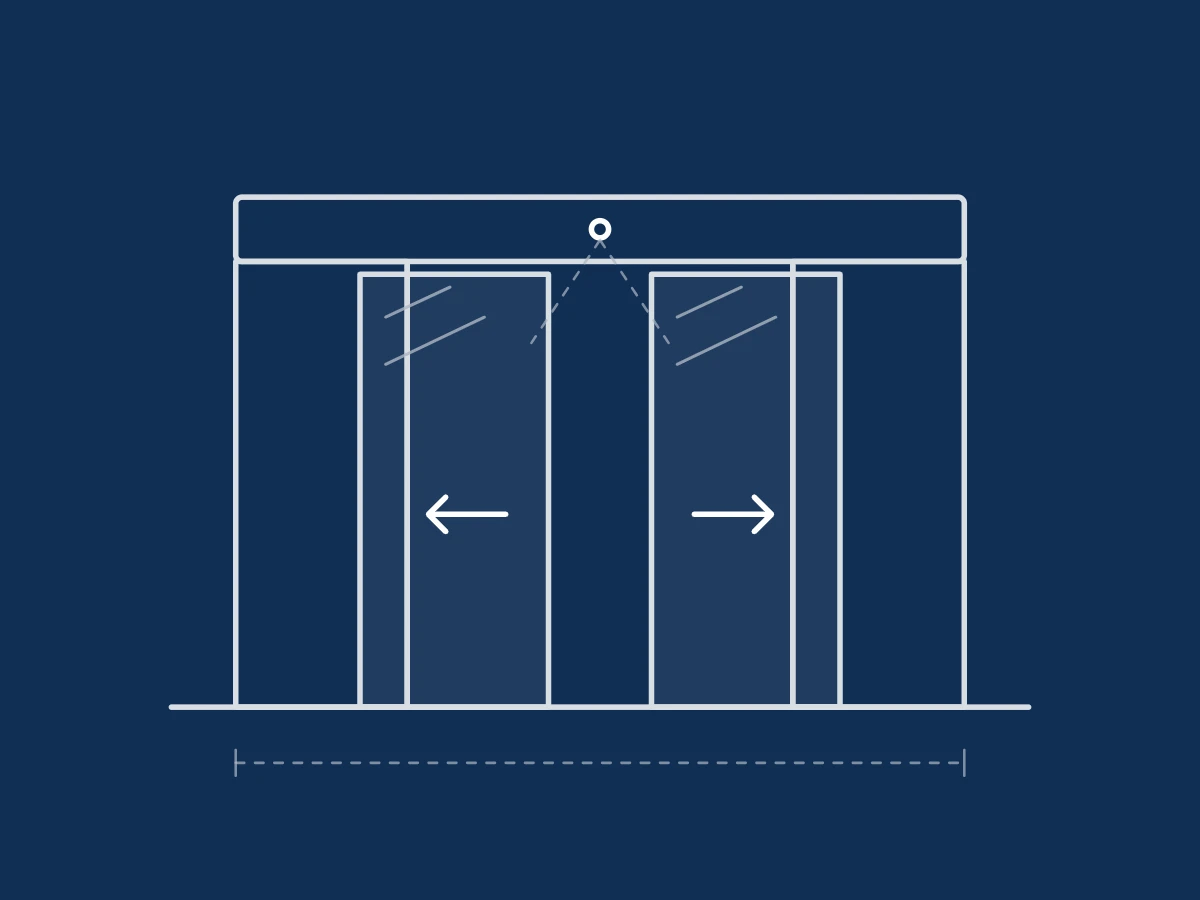
This guide is written for facility and project managers in Saudi Arabia, from hospitals and shopping centres to factories and warehouses in Riyadh, Jeddah and Dammam. It explains the types of sensors and where each is used, what is adjusted in them, and when they need re-adjustment or replacement. If you are still choosing the door itself, start with how to choose the right automatic door for your project.
Types of automatic door sensors
| Sensor | Function | Typical use |
|---|---|---|
| Microwave (radar) motion sensor | Detects approaching movement and gives the open command | Sliding and swing entrance doors, and some high-speed doors for forklift traffic |
| Active infrared presence sensor | Detects a person or stationary object in the threshold zone and prevents closing | The threshold of pedestrian doors, especially with elderly users, children, beds and trolleys |
| Combined sensor (motion + presence) | Combines activation and safety in one unit | Most modern sliding entrances |
| Door-mounted safety sensors | Prevent the moving leaf from striking a person in its path | Automatic swing doors |
| Photocells and light curtains | Detect a broken beam in the opening and stop or reverse closing | Industrial and high-speed doors, gates and barriers |
| Bottom safety edge | Stops and reverses the door on contact with an obstruction | Roller shutters, sectional doors and high-speed doors |
| Induction loop | Detects a metal vehicle above it | Car park barriers and truck entrances |
| Push buttons and manual activation | Deliberate opening instead of automatic opening | Internal entrances and doors that should not open for every passer-by |
For the door types themselves and where each fits, see types of automatic doors and where each one fits.
Activation and safety sensors: why you need both
An activation sensor on its own opens the door on approach, but it does not see a person standing still in the threshold.
The door may therefore close on a user who stops halfway, or on a trolley or bed moving slowly. A presence (safety) sensor covers this zone and prevents closing while something is in it. This is why reference standards for automatic door safety, such as EN 16005 for pedestrian doors and EN 12453 for industrial doors, require an assessment of impact and crushing risks and suitable means of protection. If your project specifies a particular standard, ask the quotation to include proof of compliance, not just a description of the sensor. Standards adopted in the Kingdom are published by the Saudi Standards, Metrology and Quality Organization (SASO).
What is adjusted in automatic door sensors?
A good sensor installed on factory settings, without adjusting it to the site, can cause daily problems. The main settings are:
- Detection field size and angle: too wide and the door opens for everyone walking past; too narrow and it opens late so users walk into it.
- Sensitivity: too high and it picks up moving curtains, plants or water on the floor; too low and it may miss a child or wheelchair.
- Direction of movement: many radar sensors can ignore movement parallel to or away from the door, reducing unnecessary openings in busy corridors.
- Slow-movement detection: important in hospitals and care facilities, where users approach slowly.
- Hold-open time: a control panel setting that works with the sensor and is set according to traffic and the type of space.
- Threshold coverage: making sure the presence sensor covers the full travel zone of the leaf.
Site conditions in Saudi Arabia and their effect on automatic door sensors
- Direct sun and heat: can affect some infrared sensors at exposed entrances, so sensor type and position are considered and settings are checked after installation.
- Dust and sandstorms: dust builds up on sensor lenses and photocells, causing false opening or stopping, so cleaning is part of every maintenance visit.
- Shiny and wet floors: can reflect the signal and cause false detection, especially when floors are washed in malls and hospitals.
- Vibration: in warehouses and factories, vibration can shift a sensor’s angle, so firm mounting and routine checks are needed.
Sensors on industrial doors and gates
On industrial doors such as high-speed doors, roller shutters and sectional doors, sensors serve two purposes: opening for forklifts and trucks without the driver getting out, and safety while closing. A radar that distinguishes vehicle movement is normally used, together with photocells or a light curtain in the opening and a bottom safety edge. On car park barriers, induction loops and photocells stop the arm from coming down on a car. Where doors are connected to an automated production line, sensors are part of the operating logic, as explained in industrial doors for automated production lines.
Signs automatic door sensors need adjustment or replacement
- The door opens when nobody approaches, or opens for everyone walking past.
- The door opens late, so users have to stop in front of it.
- The door starts closing while a person or trolley is still in the threshold.
- An industrial door does not reverse when the photocell beam is broken or the safety edge is touched.
- The door behaves differently in the morning and at midday, or after floors are washed.
Some of these symptoms are solved by cleaning and re-adjustment; others need the sensor replaced. For first steps before calling a technician, see common automatic door faults, and for a routine inspection plan see our automatic door maintenance guide.
What is checked on automatic door sensors at a maintenance visit?
- Cleaning sensor lenses and photocells.
- Testing the detection field from different directions and at different walking speeds.
- Testing the presence sensor with a stationary object in the threshold and confirming the door does not close.
- Testing reversal on industrial doors by breaking the photocell beam and touching the safety edge.
- Checking sensor mounting, angles and wiring.
- Recording any change in settings in the maintenance log.
Next step
If you have entrances that open for no reason or doors whose safety devices need assessing, request an existing system assessment or include sensors in your maintenance contract. Sensors and parts can be supplied through our spare parts service. For a new project, send the door type, location and type of users through the request a quote page.
Frequently asked questions about automatic door sensors
Why does my automatic door open by itself?
Usually because the detection field is too wide or sensitivity too high, so it picks up people passing by, moving curtains or floor reflections, and sometimes because of dust on the lens. Cleaning and re-adjustment solve most cases.
What is the difference between a motion sensor and a presence sensor?
A motion sensor detects someone approaching and opens the door; a presence sensor detects someone standing still in the threshold and prevents closing. They are used together or in a combined unit.
Can a new sensor be fitted to an existing door?
In most cases yes, provided the sensor is compatible with the control panel and door type, and it is adjusted and tested after installation.
How often should door sensors be checked?
At every preventive maintenance visit, with more frequent cleaning at dusty sites and busy external entrances.
Is a photocell enough for industrial door safety?
A photocell covers a single line in the opening, so it is usually combined with a bottom safety edge or a light curtain, depending on the door type and risk assessment.